Think & Discuss
Quick Check
Inquiry Task
The energy source shifted from biomass (whale oil) to underground fossil fuels, which exemplifies the energy transition mechanism in Section 02: demand was no longer met by biological populations, the economic incentive for whaling collapsed, and whale populations gained relief through "market substitution." This shows that energy transitions are not merely changes in prices and industries—they directly alter the probability of other species being hunted or surviving, marking a real turning point on the ecological impact curve.
It illustrates the paradox of "dependence down, impact up": food production escaped the direct constraint of soil nitrogen supply (local ecological dependence decreased), but simultaneously brought soil degradation, water eutrophication, and greenhouse gas emissions (systemic ecological impact increased). This demonstrates that escaping direct dependence is not decoupling—it is scaling extraction to a global level.
Learning Objective: Explain how the Industrial Revolution reduced Homo sapiens' dependence on natural ecosystems while simultaneously causing ecological crises and the extinction of other species.
The Industrial Revolution is typically described as an event that occurred in the second half of the 18th century: with a beginning, a climax, and an ending. But this framework obscures its true nature—it is not an event with a clear beginning and end, but a "perpetual revolution" that is still ongoing and constantly accelerating.
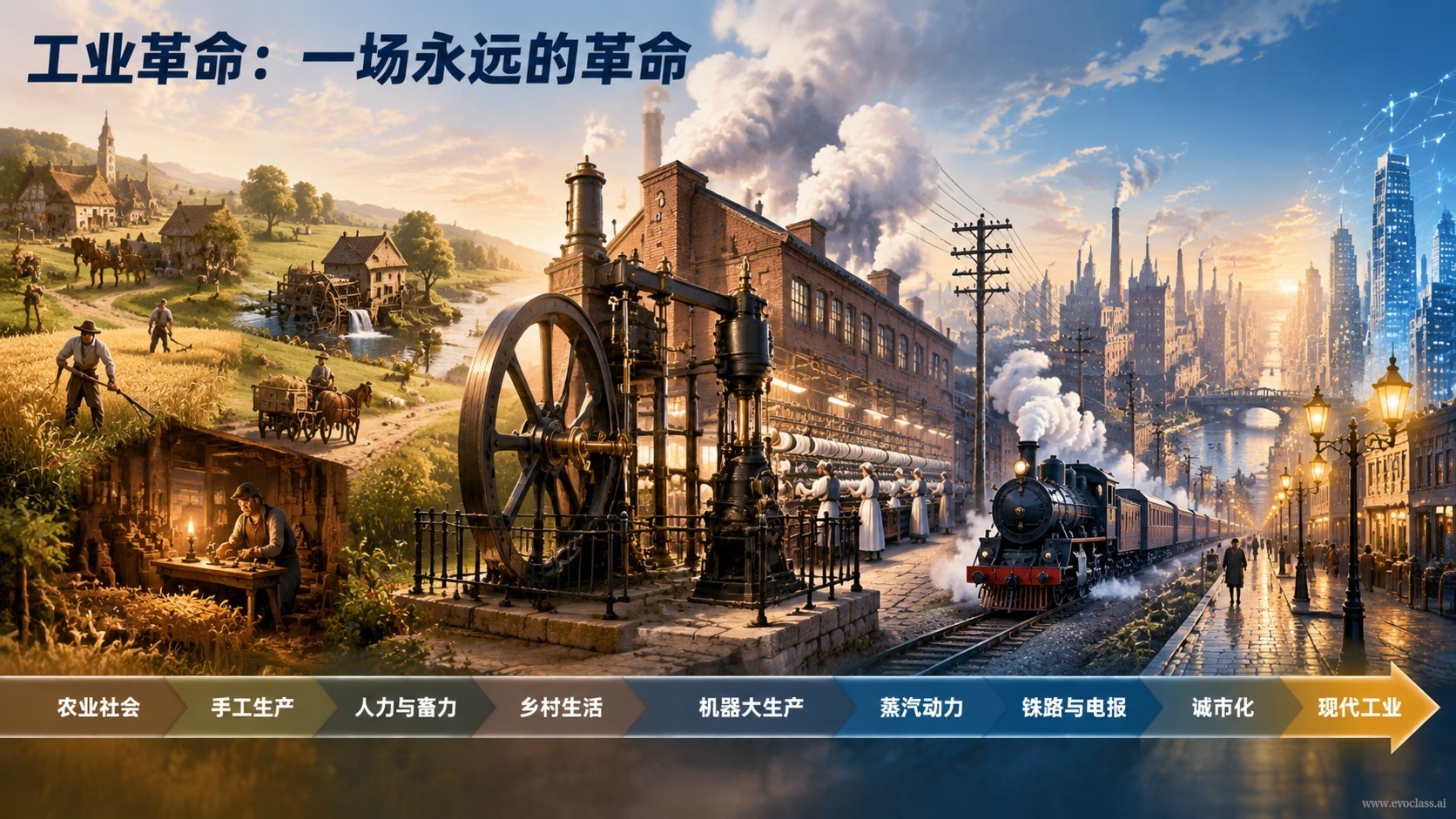
Its core is not a particular machine—not the steam engine, not the spinning jenny—but rathera fundamental transformation in how energy is converted. Its true revolutionary character lies first incontinuity: social order shifted from being "fixed by tradition" to "rewriting itself," and change no longer has an endpoint. It is for this reason that the Industrial Revolution is the shared starting point for understanding all subsequent transformations from the 19th to the 21st century (precise timetables, the restructuring of family forms, nations and consumer masses, ecological crises).
Before the Industrial Revolution, almost all production was ultimately constrained by a single energy chain:sun—plants—animals. Human and animal labor came from food, food came from plants, and plants came from photosynthesis. This meant that output was tightly locked in by arable land area, livestock numbers, and that year's harvest—hardly able to exceed the supply ceiling of the ecosystem.
The steam engine, internal combustion engine, and electricity switched the energy source to underground fossil fuels, freeing output from the constraints of arable land and livestock numbers—for the first time, Homo sapiens could potentially "no longer depend on the direct supply of natural ecosystems." Production methods transformed accordingly: commodity production shifted from handicraft, custom-made, organic economies to standardized, mechanized, and large-scale mass production, and both cost and time were redefined.
This establishes the overall framework of this page:the end of ecological dependence is simultaneously an unprecedented amplification of ecological impact.
For the first time, humans could bypass local ecosystems for food, energy, and materials, meeting needs through global trade and industrial substitutes. But this does not equal "detachment from nature"—rather, it replacedlocal dependenceon ecosystems withsystemic impacts: ecological crises, accelerated species extinction (a continuation of the three waves of extinction), and climate change. Industrialized agriculture has made livestock the largest suffering population in history—success at the species level and suffering at the individual level occur simultaneously.
A common misreading is to interpret "reduced ecological dependence" as humans "decoupling" from nature. The historical reality is the opposite: it is precisely by escaping direct dependence that humans have been able to exploit ecosystems on an unprecedented scale.
Timeline DiagramObserve the timeline diagram and consider how it relates to "the Industrial Revolution reducing human dependence on natural ecosystems."